Exploring the World: The Ways Studying Abroad Can Expand Your Mindset
- By Admin
- February 18, 2026
Overview of the Australian Student Visa
Planning to study in Australia in 2026? Then one question is probably keeping you up at night: How long will my Australian student visa take to process? You’re not alone. Every year, thousands of international students carefully prepare their academic documents, finances, and English test scores—only to find themselves anxiously refreshing their email for that visa decision.
The Australian Student Visa (Subclass 500) is the primary visa that allows international students to study full-time at a registered institution in Australia. Whether you’re applying for a bachelor’s degree, a master’s program, vocational training, or even school-level education, this visa is your official gateway to Australia.
In 2026, Australia continues to remain one of the most attractive destinations for higher education. With globally ranked universities, post-study work opportunities, and a multicultural environment, it’s easy to see why students are choosing Australia over other countries. However, immigration policies evolve, and visa processing times fluctuate based on demand, compliance trends, and government regulations.
The Subclass 500 visa allows you to:
- Stay in Australia for the duration of your course.
- Work up to permitted hours during study periods.
- Travel in and out of Australia.
- Include eligible family members.
But here’s the truth: your visa approval doesn’t just depend on ticking boxes. It depends on strategy, preparation, and timing. That’s why understanding Australian student visa processing time in 2026 is crucial.
If you’re applying from Nepal or South Asia, professional guidance can make a significant difference. Institutions like New Era Education provide expert counseling and end-to-end support to streamline your visa journey.
Let’s break everything down so you can apply with confidence—and avoid unnecessary delays.
Australian Student Visa Processing Time in 2026 – Latest Updates
So, how long does it really take in 2026?
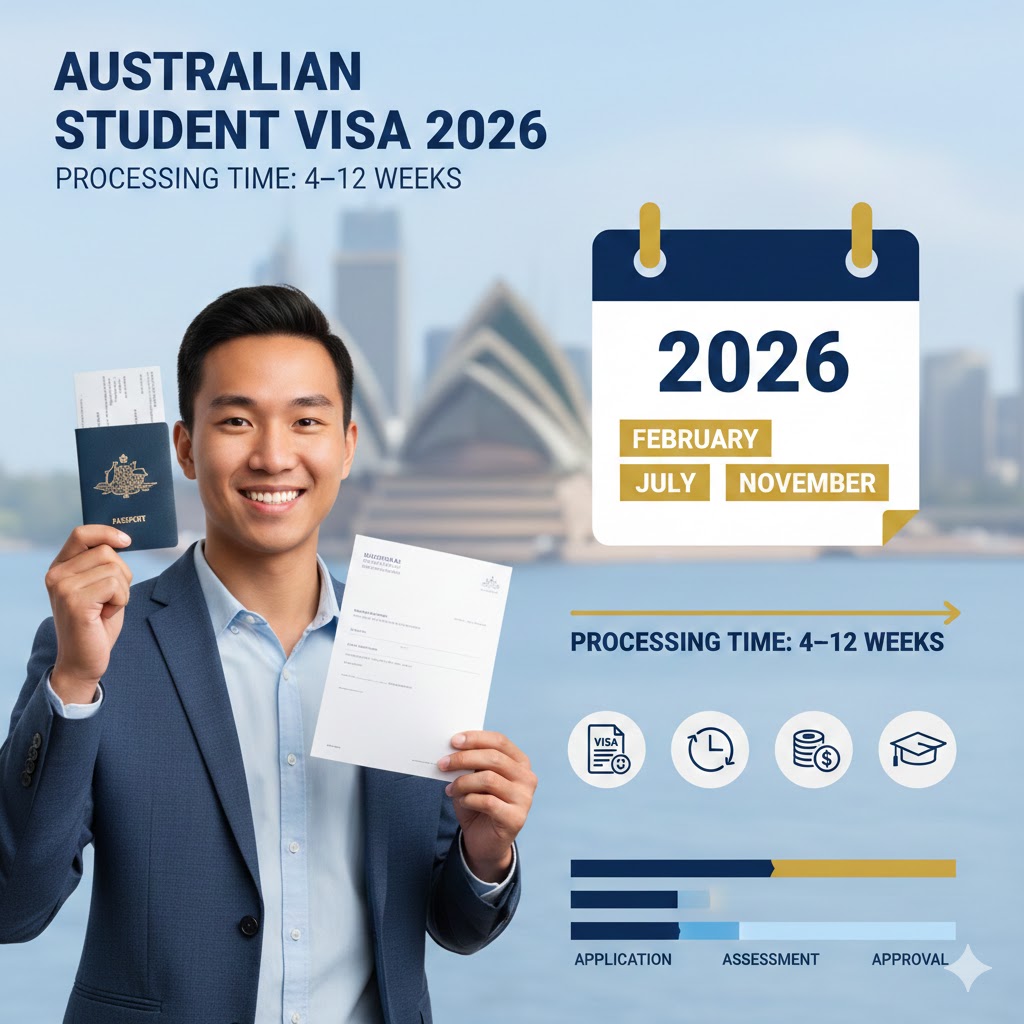
Australian student visa processing times are not fixed. They vary depending on multiple factors such as your education sector, country of application, completeness of documents, and seasonal demand. According to recent immigration data trends and application volumes, the average Australian student visa processing time in 2026 ranges between 4 to 12 weeks.
However, that’s just the headline number. The real timeline depends on your specific situation.
Average Processing Time in 2026
Here’s a general estimate:
| Education Sector | 50% of Applications Processed | 90% of Applications Processed |
| Higher Education | 4–6 weeks | 8–12 weeks |
| VET Courses | 6–8 weeks | 10–14 weeks |
| Schools | 3–6 weeks | 8–10 weeks |
| Postgraduate Research | 5–7 weeks | 10–12 weeks |
These timelines are indicative and may change based on government workload and policy updates.
Peak seasons—particularly before February and July intakes—often result in slower processing. Imagine thousands of applications hitting the system at once. It’s like traffic during rush hour. The earlier you apply, the smoother your ride.
Another major factor in 2026 is the stricter assessment under the Genuine Student (GS) requirement. Immigration officers are closely examining whether applicants genuinely intend to study. A poorly written statement can slow your process significantly.
To avoid delays, many students begin their application 4–5 months before their course start date. If you’re unsure about timing, professional advisors at New Era Education – Study in Australia can help you map out a strategic application timeline.
In short? The earlier and cleaner your application, the faster your visa decision.
Factors Affecting Australian Student Visa Processing Time
Ever wondered why your friend got their visa in 3 weeks while someone else waited 3 months? The difference lies in the details.
Let’s unpack the real factors affecting Australian student visa processing time in 2026.
Application Completeness
Think of your visa application like a puzzle. If even one piece is missing, the whole picture is incomplete. Immigration officers may request additional documents, which resets your waiting clock.
Common mistakes include:
- Missing bank statements
- Incorrect financial calculations
- Unverified academic transcripts
- Incomplete Genuine Student statements
A “front-loaded” application—where you submit all documents correctly the first time—moves significantly faster.
Financial Documentation
Australia requires strong proof that you can cover tuition fees, living expenses, and travel costs. In 2026, financial scrutiny is tighter than ever. Immigration authorities carefully examine:
- Source of funds
- Consistency of income
- Sponsorship legitimacy
- Loan documentation
If anything appears unclear or inconsistent, processing may be delayed for verification.
Genuine Student (GS) Requirement
This is a big one.
The GS requirement replaced previous frameworks and focuses on whether your study intentions align with your background and future plans. Your statement should clearly explain:
- Why you chose Australia
- Why you selected your course
- How it connects to your career goals
- Your ties to your home country
A vague or copied statement is one of the fastest ways to delay or jeopardize your application.
Health and Character Checks
Medical examinations and police clearance certificates must meet Australian standards. Delays often occur if:
- Medical tests are incomplete.
- Additional health assessments are requested.
- Police clearance documents are outdated.
Country Risk Level & Immigration Trends
Applications from certain countries may undergo additional scrutiny depending on compliance rates. This doesn’t mean rejection—but it may mean longer assessment times.
That’s why working with experienced consultants, such as New Era Education’s visa experts, can make a measurable difference. They understand documentation trends and help you avoid common red flags.
The bottom line? Visa processing time isn’t random. It’s influenced by preparation, accuracy, and strategy.
Step-by-Step Australian Student Visa Application Process in 2026
Applying for an Australian Student Visa in 2026 isn’t complicated—but it is detailed. Think of it like building a house. If the foundation isn’t strong, the entire structure becomes unstable. The same applies to your visa application. A well-prepared, step-by-step approach can significantly reduce processing delays.
Let’s walk through the entire journey so you know exactly what to expect.
Step 1 – Receive Confirmation of Enrolment (CoE)
Before you can even apply for a visa, you must secure admission to a CRICOS-registered Australian institution. Once you accept the offer and pay the required deposit, the institution issues your Confirmation of Enrolment (CoE).
This document is non-negotiable. It confirms:
- Your course details
- Duration of study
- Tuition fee structure
- Start and end dates
Without the CoE, your visa application cannot proceed.
Step 2 – Prepare Required Documents
This is where most students either speed ahead—or slow down their entire timeline. You’ll need:
- Valid passport
- Academic transcripts and certificates
- English language test results (IELTS/PTE/TOEFL)
- Financial evidence
- Genuine Student (GS) statement
- Overseas Student Health Cover (OSHC)
Preparing these documents early ensures you’re not scrambling at the last minute.
Step 3 – Lodge Online Application
Applications are submitted through Australia’s official ImmiAccount portal. Accuracy matters here. One incorrect detail can lead to delays or even refusals.
Step 4 – Biometrics & Medical Examination
Depending on your country of residence, you may be required to provide biometrics and complete a health examination. Book these as soon as requested to avoid unnecessary waiting time.
Step 5 – Visa Decision
Once everything is submitted and verified, your application enters assessment. You’ll receive updates via email. If approved, your visa grant letter will outline conditions and duration.
Working with experienced professionals like New Era Education ensures every step is executed correctly the first time. That alone can shave weeks off your processing timeline.
Required Documents for Faster Visa Processing
Here’s the honest truth: Australian immigration isn’t just checking if you submitted documents—they’re evaluating whether those documents make sense together. Consistency and clarity are everything in 2026.
Let’s break down the most critical paperwork.
Financial Documents
You must demonstrate sufficient funds to cover:
- One year of tuition fees
- Living expenses (as per current Australian immigration benchmarks)
- Travel expenses
Acceptable financial proof may include:
- Bank savings
- Education loans
- Fixed deposits
- Sponsor income statements
The source of funds must be legitimate and clearly traceable. Sudden large deposits without explanation raise red flags. Immigration officers carefully review transaction histories.
English Language Test Results
Most students must provide IELTS, PTE, TOEFL, or equivalent test scores. Minimum score requirements vary by institution and course level. Always confirm requirements before booking your exam.
Academic Transcripts
Submit certified copies of:
- Secondary education certificates
- Bachelor’s or master’s degree transcripts (if applicable)
- Professional certificates (if relevant)
Consistency between your academic background and chosen course strengthens your GS statement.
SOP & Genuine Student Statement
This is where you tell your story.
Your statement must:
- Clearly explain your academic progression
- Justify your course selection
- Demonstrate future career plans
- Show strong ties to your home country
Avoid generic or copied content. Immigration officers can spot templates instantly.
Professional guidance from New Era Education’s documentation experts can help craft a compelling, genuine statement that aligns with immigration expectations.
How to Reduce Australian Student Visa Processing Time in 2026
Everyone wants the same thing: a faster visa decision. While you can’t control government workload, you can control your preparation.
Here’s how to improve your timeline.
Apply Early
Don’t wait until the last minute. If your intake begins in February 2026, start preparing by September or October 2025. Peak seasons dramatically increase processing times.
Submit a Front-Loaded Application
A front-loaded application includes all required documents at submission. This reduces back-and-forth communication and speeds up assessment.
Ensure Financial Transparency
Clearly explain the source of funds. Attach supporting documents that prove legitimacy and continuity of income.
Respond Quickly to Requests
If immigration requests additional information, respond immediately. Delays in response extend your timeline.
Work With Certified Education Consultants
Experienced consultants understand:
- Documentation trends
- Visa refusal patterns
- GS statement expectations
- Common red flags
Students applying through reputable consultancies like New Era Education – Study Abroad Experts often experience smoother processing because their applications are professionally reviewed before submission.
Think of it like hiring a navigator for a complex journey. You can drive alone—but a guide helps you avoid wrong turns.
Visa Fees and Financial Requirements in 2026
Budget planning is essential when preparing for Australia.
Updated Visa Fees
As of 2026, the Australian Student Visa (Subclass 500) application fee is approximately AUD 710–750 (subject to government updates). Additional charges may apply for:
- Dependents
- Health examinations
- Biometrics
- Police clearance certificates
Always verify current fees on the official immigration website before applying.
Proof of Funds Requirements
In 2026, the estimated living expense requirement is aligned with updated immigration benchmarks. Students should prepare for:
- Annual living expenses (as per Department of Home Affairs guidelines)
- Tuition fee for 12 months
- Travel costs
Financial evidence must demonstrate genuine access to funds—not just temporary availability.
Careful financial planning ensures both smoother visa processing and a stress-free transition to Australia.
Common Reasons for Visa Delays or Rejection
Understanding what not to do is just as important as knowing what to do.
Incomplete Documentation
Missing or inconsistent documents trigger information requests. Each request adds weeks to your timeline.
Weak Genuine Student Statement
A vague explanation of career goals or course choice is a common refusal reason. Your academic and career narrative must align logically.
Financial Inconsistencies
Large unexplained deposits, unverifiable sponsor income, or insufficient proof of funds are major red flags.
Previous Visa History Issues
If you’ve had prior visa refusals (for any country), you must disclose and explain them properly.
The difference between approval and refusal often lies in detail. That’s why expert review through New Era Education can provide an added layer of confidence.
Australia Intake Timeline 2026 – When Should You Apply?
Timing can make or break your visa strategy.
February Intake
Largest intake with highest application volume. Apply at least 4–5 months in advance.
July Intake
Second-largest intake. Apply 3–4 months prior.
November Intake
Smaller intake, often faster processing due to lower volume.
Starting early gives you flexibility if unexpected delays occur.
Why Choose New Era Education for Your Australian Student Visa?
Applying for an Australian student visa is more than filling out forms—it’s about presenting a strong, credible profile.
New Era Education offers:
- Personalized course counseling
- University application support
- Genuine Student statement guidance
- Financial documentation review
- Pre-departure briefing
Their expertise in Australian education pathways ensures students submit applications aligned with immigration standards.
Instead of navigating policy changes alone, you gain structured, strategic guidance.
Explore more at:
👉 https://newera.edu.np/
Conclusion
Australian student visa processing time in 2026 typically ranges from 4 to 12 weeks, depending on your education sector, documentation quality, and seasonal demand. While immigration timelines fluctuate, preparation remains the strongest factor within your control.
A complete, front-loaded application with clear financial evidence and a strong Genuine Student statement dramatically improves your chances of faster approval.
Start early. Stay organized. Seek expert guidance if needed.
Australia offers world-class education and global career opportunities. With the right strategy, your visa journey can be smooth and successful.
FAQs About Australian Student Visa Processing Time 2026
1. How long does an Australian student visa take in 2026?
Most applications are processed within 4–12 weeks, depending on education sector and documentation completeness.
2. Can I fast-track my Australian student visa?
There is no official fast-track option, but submitting a complete, front-loaded application can reduce delays.
3. When should I apply for February 2026 intake?
Ideally 4–5 months before your course start date.
4. Does applying through an education consultancy improve visa chances?
While approval depends on individual merit, experienced consultants help minimize errors and strengthen documentation.
5. What is the most common reason for visa delays?
Incomplete financial documentation and weak Genuine Student statements are the most common causes.
YOU MAY ALSO LIKE